about
Who I am, what I build, and how to reach me.
I’m Daniel Poelzleithner — systems architect from Germany. I write Linux and systems software, build small sharp tools in Rust and Nix, and poke at embedded hardware when the mood strikes. I like software the way I like the universe: deterministic, composable, and running like a very large clock.
Most of my energy currently goes into an unannounced project: a decentralized runtime for autonomous AI systems — not one entity, but a system of systems sharing an environment and exchanging intelligence. Rust and Nix at the bottom, distributed trust at the top. It doesn’t have a public name yet. Soon.
Some of what I’ve built lives on GitHub: a latency-tuning Linux daemon, watch firmware, a Trojan-Source-hunting Unicode scanner, and other odds and ends. The full list is on the projects page.
the other 148 bpm
After dark I play psytrance as voxel.blue — hi-tech, darkpsy, psycore, twilight, with the occasional old-school, goa or suomi set. (Yes, I just like voxels — I don’t write graphics engines.)
the head
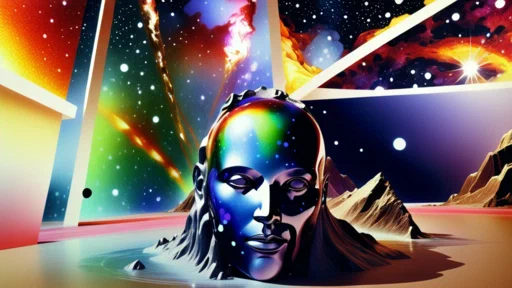
The chrome head on the front page came out of camera-magica, an AI photo pipeline I built. It was rendered from a photo of me taken at the Chaos Communication Congress. On the home page it gets voxelized live, cube by cube — because of course it does.
how I think
I studied philosophy and physics — and concluded that physicists are not philosophers enough, and philosophers are not physicists enough. I still think that’s the most load-bearing sentence of my education. I bet on outlier geniuses over consensus: the ideas worth reading properly are usually decades ahead of common belief and sound wrong at first hearing (science measurably sleeps on its best work for decades). Where that leads me in physics lives on the physics page — including a standing $50k bet.
Years in Freifunk mesh networking taught me distributed systems the hard way — mesh is the combination of the worst problems physics can throw at technology, literally. It also taught me the fragility of systems in general: biological, technical, societal. I’ve been wrong in both directions about how fast systems break, and the lesson that stuck is that fragility hides in the couplings, not the components.
I sat Vipassana (dhamma.org) intensively — whole semester breaks, six-plus weeks in the center. It shows you the interconnection between mind, body, experience and memory, and how to heal — and it quietly falsified a good share of the philosophy shelf for me: if a philosophical edifice rests on assumptions that simple, quiet, detailed, unbiased observation can refute, its conclusion is the empty set, and my time is too precious for empty sets.
Biohacker, nerd, architect of mind-bending distributed systems — usually alone out there, always early.
elsewhere
Find me on the links in the footer. The fastest way to reach me is email.
If this site feels too calm, typing psy still works — but if you want the
colors to really move, you’ll have to arouse me in real life. ;)